

As a STEM instructor, how much time do you spend negotiating over partial credit?
"Can I get two points back on question 3?"
"Why did I lose half a point for my axis labels?"
Traditional points-based grading often turns lab reports into a game of point-haggling instead of a journey toward deep learning. Worse, "effort" points, often from an instructor’s empathy, can introduce unintended grading bias and obscure whether a student has actually mastered a concept.
Enter Specifications Grading (or "Specs Grading"); an approach that swaps partial credit for clear, standards and mastery-based retries.
Here is how specifications grading works, why it transforms student depth of knowledge, and how you can implement it seamlessly with Catalyst Education.
What is Specifications Grading?
Pioneered by Dr. Linda Nilson, in specifications grading students are provided with explicit learning objectives for a course and each assignment is aligned with those objectives.
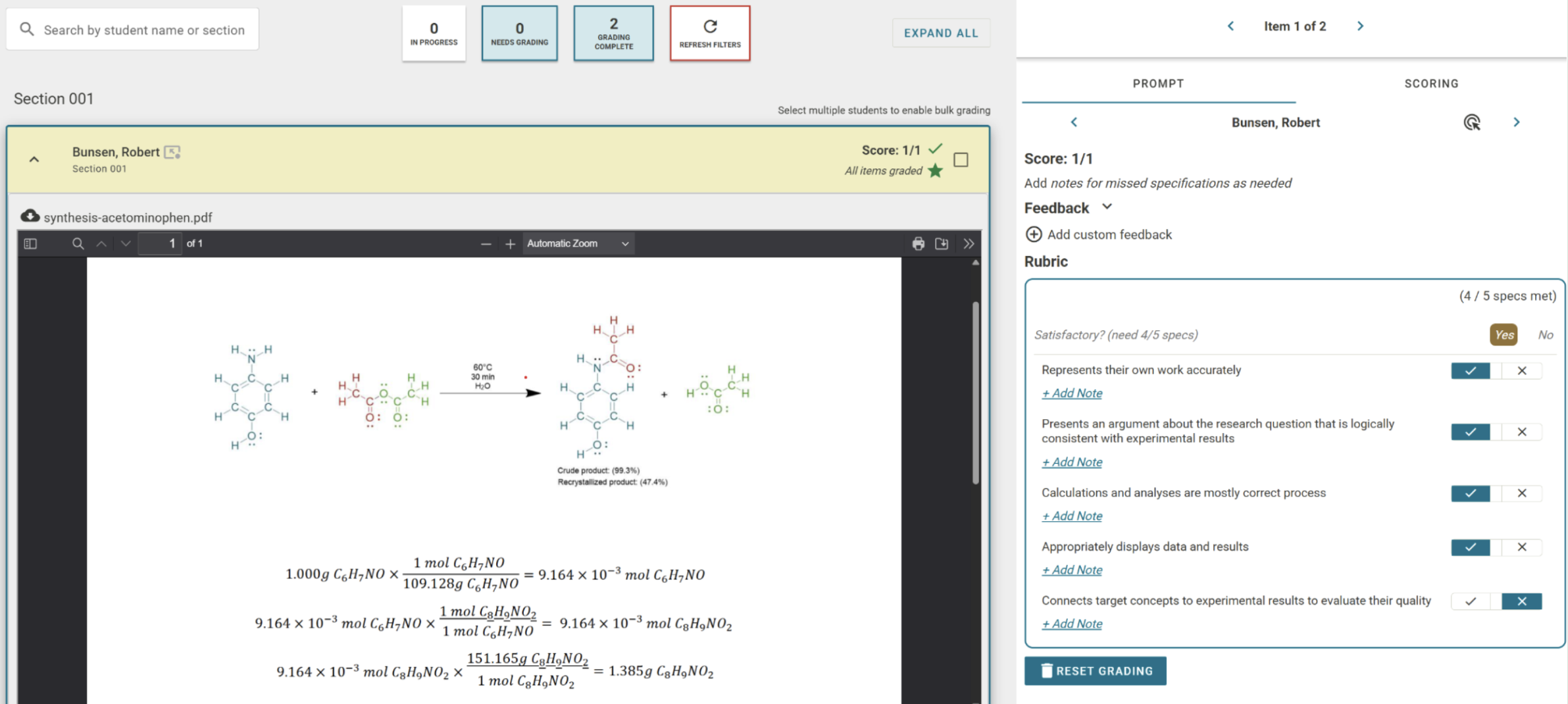
The specifications rubrics evaluates student work against a clear set of one-dimensional criteria on a Satisfactory/Unsatisfactory basis. Ideally, students are then provided with opportunities to resubmit work that was initially unsatisfactory in efforts to master the skill or criteria.
There is no 85% or C+ on an individual lab report. Work either meets all published specs or it doesn’t. The overall course grade is dependent on the number of course objectives mastered by the student and bundled assignment thresholds.
Why Make the Switch to Specifications Grading?
Eliminates Bias on "Effort Points": Traditional rubrics often reward compliance or neatness rather than actual understanding. It can also be easy to award effort with partial credit, even if the content misses the mark. Specs grading evaluates strictly against concrete criteria.
Drives Deep Learning: When partial credit isn't an option, students can't "fudge" a section and rely on curve padding. They must understand the material or harness a skill to earn credit.
Reduces Grading Friction: Graders don't need to debate whether an error is worth a 2-point or 3-point deduction. The criteria are explicitly met or unmet.
Encourages Growth Mindset: Pairing specs grading with opportunities to revise changes failure from a dead end into a feedback and learning loop.
The Secret for Success: Unlocking Retries with Tokens
A pure "Pass/Fail" system without retries creates anxiety. However, unlimited retries create an unsustainable grading load for faculty and TAs.
The solution? Earned retries.
Several courses successfully pair Catalyst’s report grading and the Token Economy:
Earn Tokens: Students earn tokens through positive learning habits like completing pre-lab quizzes early, watching videos, or participating in class interactions powered by Catalyst.
Receive Targeted Feedback: After submitting a lab report in Labflow, students review their specifications rubric to see exactly which specs were missed.
Purchase a Retry: Students spend earned token(s) to submit a revised report addressing only the unfulfilled specs.
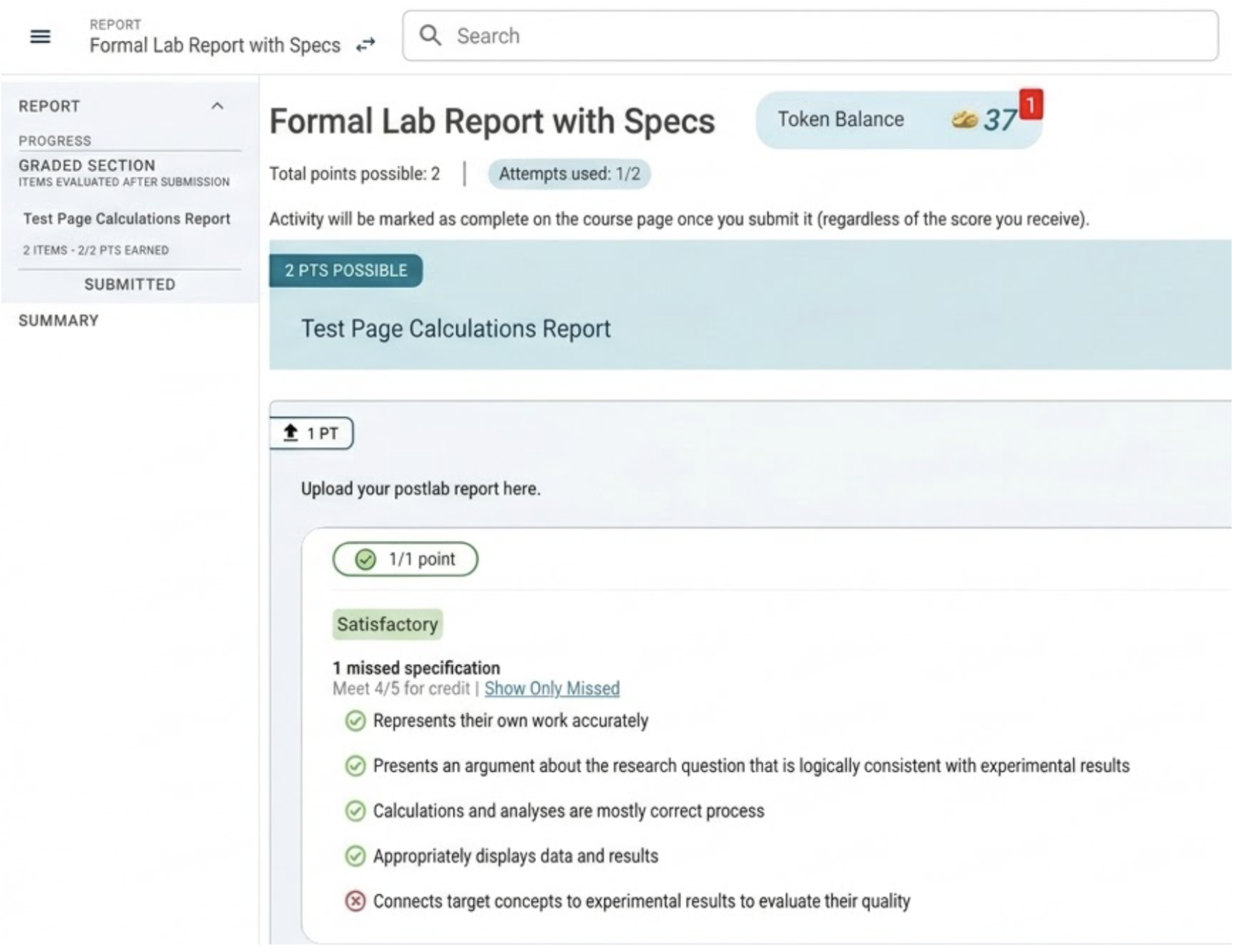
This creates a powerful feedback loop: positive engagement outside of the lab directly funds opportunities to demonstrate mastery on major assignments.
Why Specs Grading Works
Open-access educational research supports moving away from traditional point-accumulation models:
Lower Stress & Clearer Expectations: Research demonstrates that specifications grading reduces student anxiety regarding "where points went" while increasing transparency around course objectives (Nilson, 2014).
Improved Mastery & Retention: Studies in undergraduate STEM courses show that allowing targeted resubmissions against clear rubrics significantly improves student retention of core concepts compared to standard partial-credit grading (Elkins et al., 2021).
Fostering Metacognition: Requiring students to evaluate their own work against explicit specifications before submission enhances metacognitive skills and self-directed learning (Streifer & Sibley, 2020).
Bring Specifications Grading to Your Lab
Whether you teach General Chemistry, Organic Chemistry, Biology, Physics, or Psychology, transitioning to specifications grading does not mean rewriting your entire course from scratch.
With Catalyst's flexible rubrics and built-in token economy, you can build a fair, transparent, and mastery-focused lab curriculum that cuts down on point-haggling and elevates student learning.
Ready to see specifications rubrics and token retries in action? Reach out to your Faculty Success Manager (FSM)!